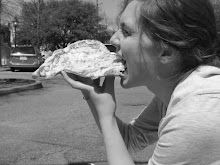
Ok, so I went to Club Grub today and I was being the "background lady" and trying to soak up as much as possible, and I realized at the end that I was totally misinterpreted by the club people, and now I'm a member, I guess.
So, I'm probably ruining my story. Ugh. I'll have to talk about it.
In funny news, Club Grub was going over healthy versus non-healthy foods and as they were shouting out things like "oranges!" and "kiwi" I heard the following:
Kid: "I'm going to go to McDonalds or Burger King after this."
Some habits you just can't break.
Tuesday, April 28, 2009

My housemate keeps playing "Walking on broken glass"
I was just reading through some comments and I think Aaron does bring up a good point about what is more appealing in a story, "cute vs. tragic."
Like the old-timer I am, It reminds me of a story. One day I picked up my local newspaper to see a picture of kids playing in sprinklers on the front page.
"Really?" I asked, reading the equally flowery caption. "All that's going on and they put a picture some kids playing around in sprinklers above the fold?" I was being critical, edgy, like an angry Bruce Wayne peering down at the sinful Hillsdale County with all the rogue farmers and shifty Amish clomping around with their devil horses looking for trouble.
"Why not?" my dad asked, jolting me out of my self-involved fantasy. "What's wrong with focusing on something good and happy for a change? We're always seeing news about wars and death tolls."
I felt stupid, thought about getting defensive, but in the end let my silence speak for me. "Yeah, you're absolutely right," it echoed. The kids' bright swimsuits and expressive faces were making people smile and remember the simplicity of summer afternoons, why the hell was I complaining?
Not to get defensive now, but I guess because in my desire to write fiction, I learned that there has to be some conflict, some sort of deeper meaning that makes something worthy of reading. Or I thought I learned that. I wrote a story as a spacey teenager about the future me getting a job as a disc jockey in Florida and meeting amazing people and having this angsty sexual tension with my male housemate who I thought I hated for the first few months (there was a communication meltdown somewhere that led to us rooming together). But I never ended the story. I had tons of them. These happy what-if stories going on forever and ever. I guess when I write and read stories I like gritty real-life situations. They don't make me happy, but I like reading what I perceive as something closer to reality that sets it apart from the rainbow stories of my youth. Who knows.
I did love the Memory story, though, and I think that was mostly positive. It was turning this rest home life into something beautiful. They've lost so many people whom they loved, but have found avenues and new relationships that keep them going and give meaning to their lives. The story never overtly asks the question "Why am I still here?" but it was present throughout the piece. They live in a world mixed with past and present, the memories of their lost loved ones are as much present as characters as those still in the home. Rest homes are so fascinating. Also, on page 376, I laughed out loud several times at the line "The tiny Fleur, the woman who was always wanting to call her mother on the phone, asked the room in general, 'We havin' a party or somethin'?'" That's both cute and tragic, we've come full circle. I think Keely Houghton would think that was funny, too.
Telling True Stories
I'm really starting to appreciate the zoom in metaphor, because the more I think about it, the more the narrative story about the underground music scene I wrote last fall seems a little like a summary. I'm not sure, I'd have to read it over again.
I brought up the summary vs. dramatic narrative in one of my other English classes when talking about Mrs. Dalloway. I think that utilizes some dramatic narrative. I can dig it.
Like the old-timer I am, It reminds me of a story. One day I picked up my local newspaper to see a picture of kids playing in sprinklers on the front page.
"Really?" I asked, reading the equally flowery caption. "All that's going on and they put a picture some kids playing around in sprinklers above the fold?" I was being critical, edgy, like an angry Bruce Wayne peering down at the sinful Hillsdale County with all the rogue farmers and shifty Amish clomping around with their devil horses looking for trouble.
"Why not?" my dad asked, jolting me out of my self-involved fantasy. "What's wrong with focusing on something good and happy for a change? We're always seeing news about wars and death tolls."
I felt stupid, thought about getting defensive, but in the end let my silence speak for me. "Yeah, you're absolutely right," it echoed. The kids' bright swimsuits and expressive faces were making people smile and remember the simplicity of summer afternoons, why the hell was I complaining?
Not to get defensive now, but I guess because in my desire to write fiction, I learned that there has to be some conflict, some sort of deeper meaning that makes something worthy of reading. Or I thought I learned that. I wrote a story as a spacey teenager about the future me getting a job as a disc jockey in Florida and meeting amazing people and having this angsty sexual tension with my male housemate who I thought I hated for the first few months (there was a communication meltdown somewhere that led to us rooming together). But I never ended the story. I had tons of them. These happy what-if stories going on forever and ever. I guess when I write and read stories I like gritty real-life situations. They don't make me happy, but I like reading what I perceive as something closer to reality that sets it apart from the rainbow stories of my youth. Who knows.
I did love the Memory story, though, and I think that was mostly positive. It was turning this rest home life into something beautiful. They've lost so many people whom they loved, but have found avenues and new relationships that keep them going and give meaning to their lives. The story never overtly asks the question "Why am I still here?" but it was present throughout the piece. They live in a world mixed with past and present, the memories of their lost loved ones are as much present as characters as those still in the home. Rest homes are so fascinating. Also, on page 376, I laughed out loud several times at the line "The tiny Fleur, the woman who was always wanting to call her mother on the phone, asked the room in general, 'We havin' a party or somethin'?'" That's both cute and tragic, we've come full circle. I think Keely Houghton would think that was funny, too.
Telling True Stories
I'm really starting to appreciate the zoom in metaphor, because the more I think about it, the more the narrative story about the underground music scene I wrote last fall seems a little like a summary. I'm not sure, I'd have to read it over again.
I brought up the summary vs. dramatic narrative in one of my other English classes when talking about Mrs. Dalloway. I think that utilizes some dramatic narrative. I can dig it.
Wednesday, April 22, 2009
Outline attempt
Conflict: Marni bruises flower
Development: 1. Family loves Marni
2. Marni buys flower
3. Marni loses way
Resolution: Family loves flower
I guess.
Development: 1. Family loves Marni
2. Marni buys flower
3. Marni loses way
Resolution: Family loves flower
I guess.
Tuesday, April 21, 2009
She did it on time (for once)
All of the readings we have for this Wednesday I think brought up some ethical questions. It started with the beginning of the Telling True Stories section, specifically page 31 "I laugh at their jokes, whether I think they're funny or not." This came after a string of do's and don't's Isabel Wikerson came up with, and I know what she's saying and I may even agree with her, but I can't get the image out of my mind of someone being fake to get more information so they can turn around and write a negative profile. Like, someone makes a sexist joke, the interviewer laughs and then in the piece the person is portrayed as a sexist, and the part where the interviewer laughed (thus egging them on) isn't included and I think that's absolutely dishonest. It seems Wikerson may be trying to say to go along with what people are saying without inserting your own personality or interests and make the interviewee as comfortable as possible, but this is where I think things get blurry. It could go either way.
I mean, this whole class is based on this idea of truth or pieces of truth from a single perception that I have always picked apart in other settings. You can only get a little subjective piece of a person with a profile and that's that.
On to the actual narrative pieces: The American Man at Age Ten.
Hmm. Other than making me extremely nostalgic and missing my brothers and episodes of G.I. Joe, I found myself asking, "Why was this written?" Reading it in 2009 is fun in some ways, but I think it's fun in the same way that watching Kindergarten Cop every few years is fun. You get a couple good laughs in at the video game technology, the fashion, the icons (Schwarzenegger) but you don't watch it to get a deeper meaning out of anything. Also, I think if I picked up an issue of Esquire in the early 90s and read this story, I would think it was either cute or pointless. I like that she wanted to interview an oridinary kid instead of a celebrity, but I think this piece proves why people would rather read about celebrities. There's an abundance of 10-year-old boys who think stealing things from girls they call Maggot is flirting.
Trina and Trina was different. It was gripping, tragic, and frustrating. It also had that element of culture from the mid-90s, but it also had a clear and crazy-dramatic conflict. This is going to be a really fun piece to talk about, because I think Leblanc overstepped her boundaries at points, and I wonder how writing this story affected her relationship with Trina. It was gritty and disgusting in some parts, but I think it was true. Although I just wanted Trina admitted somewhere the whole time, I realize between her rebellion and bureacracy it wasn't as easy as Lifetime makes it seem sometimes. This is a great example of a piece where the author is present throughout, and I'm not sure I really liked the author that much. She wasn't awful, but she wasn't a likable character I was drawn to. It made it even more real. Oh! I remember what this reminds me of (of what this reminds me?). I read a bunch of stories like this my first year in a Prisons and Public Policy class. This is exactly how it is, people try rehab, they try starting over, but they always end up back on the streets doing what they know best. It's frustrating and tragic, but it's how these societies work. It's hard to get back in the system when you've spent so long staying out of it.
I mean, this whole class is based on this idea of truth or pieces of truth from a single perception that I have always picked apart in other settings. You can only get a little subjective piece of a person with a profile and that's that.
On to the actual narrative pieces: The American Man at Age Ten.
Hmm. Other than making me extremely nostalgic and missing my brothers and episodes of G.I. Joe, I found myself asking, "Why was this written?" Reading it in 2009 is fun in some ways, but I think it's fun in the same way that watching Kindergarten Cop every few years is fun. You get a couple good laughs in at the video game technology, the fashion, the icons (Schwarzenegger) but you don't watch it to get a deeper meaning out of anything. Also, I think if I picked up an issue of Esquire in the early 90s and read this story, I would think it was either cute or pointless. I like that she wanted to interview an oridinary kid instead of a celebrity, but I think this piece proves why people would rather read about celebrities. There's an abundance of 10-year-old boys who think stealing things from girls they call Maggot is flirting.
Trina and Trina was different. It was gripping, tragic, and frustrating. It also had that element of culture from the mid-90s, but it also had a clear and crazy-dramatic conflict. This is going to be a really fun piece to talk about, because I think Leblanc overstepped her boundaries at points, and I wonder how writing this story affected her relationship with Trina. It was gritty and disgusting in some parts, but I think it was true. Although I just wanted Trina admitted somewhere the whole time, I realize between her rebellion and bureacracy it wasn't as easy as Lifetime makes it seem sometimes. This is a great example of a piece where the author is present throughout, and I'm not sure I really liked the author that much. She wasn't awful, but she wasn't a likable character I was drawn to. It made it even more real. Oh! I remember what this reminds me of (of what this reminds me?). I read a bunch of stories like this my first year in a Prisons and Public Policy class. This is exactly how it is, people try rehab, they try starting over, but they always end up back on the streets doing what they know best. It's frustrating and tragic, but it's how these societies work. It's hard to get back in the system when you've spent so long staying out of it.
Monday, April 20, 2009
My story idea, yo
I'm planning on interviewing a woman at a local old folk's home in Hillsdale County. I have yet to hear back if she is still in this home, but if she isn't, there are plenty of nice women I could profile, who have interesting stories. The conflict, if there isn't one already in their lives, is living at this home (which I can't remember the name of) because the place is more of a harshly lit factory than a happy place to stay for their last months/years. I think it's called Medical Care.
Wednesday, April 15, 2009
People on the streets, da da dee doe dep
So I read the narrative pieces for today, and I was waiting for the part in the Rio story Joseph posted for the Robby Fisher conversation to come back into the story. Although I gave good 'ol Franklin a hard time in my last post, he was absolutely correct bringing up the shotgun image. Luckily, the very last sentence refrenced the Fisher conversation and all was well in the universe.
I liked the piece Jackie posted because it was both illuminating and humorous all at once. Gill was able to laugh at the fact that you could buy anything at the intersections and also show the huge disparity between the classes. I loved how it came back at the end when Mr. Bhogilal pulls out a plastic photo album that could be bought in the intersections, but it's filled with pictures of cars. Such a poignant juxtaposition.
From Jackie's article, I was intrigued by a link on the sidebar of a video of Christopher Hitchens getting waterboarded for a story. So I checked it out and it was disturbing how little he could stand it before he dropped the metal rod that meant it would all end. It lasted maybe 8 seconds. They were talking about fifteen on and off until they worked up to thirty, and I'm not sure if they meant seconds or minutes but either way, it's truly torture what the Guantanamo Bay prisoners endure. That flowed nicely into Elizabeth's article about Swift and his attempts to aid his client in Guantanamo Bay. It's a very long article.
I liked the piece Jackie posted because it was both illuminating and humorous all at once. Gill was able to laugh at the fact that you could buy anything at the intersections and also show the huge disparity between the classes. I loved how it came back at the end when Mr. Bhogilal pulls out a plastic photo album that could be bought in the intersections, but it's filled with pictures of cars. Such a poignant juxtaposition.
From Jackie's article, I was intrigued by a link on the sidebar of a video of Christopher Hitchens getting waterboarded for a story. So I checked it out and it was disturbing how little he could stand it before he dropped the metal rod that meant it would all end. It lasted maybe 8 seconds. They were talking about fifteen on and off until they worked up to thirty, and I'm not sure if they meant seconds or minutes but either way, it's truly torture what the Guantanamo Bay prisoners endure. That flowed nicely into Elizabeth's article about Swift and his attempts to aid his client in Guantanamo Bay. It's a very long article.
I knew a kid in grade school named Jon Franklin
There's no doubt that Franklin did something right, that he hit some chord that reverberated in editors' souls everywhere. Unfortunately, I didn't swoon at Franklin's prose--which made reading the 200-something page book a little painful. From the beginning, I was put off by what I read as Franklin's arrogance. Yes, he won two Pulitzer Prizes, and that's one heck of an achievement, but after 50 pages of "here's where most writers go wrong, and here's why I succeed" I started feeling a hierarchy set up that by nature I wanted to resist.
His narrative pieces are uncomfortably reminiscent of children's books. He overuses the ellipsis, for starters, and he does it in a way that makes me picture the narrator as either a melodramatic actor, or an excited child.
"One of his student teachers was a young lady named Geneva Crouch...and...and she was one of the prettiest women he had ever seen" (53).
"And yet...somehow...without it he would perish" (45).
"It had a romantic sound, rich with rhythm and vowels, and to hear the incomprehensible words filled hime with a restless, inarticulate lust to...to...to go" (42).
I appreciate, on the other hand, that this means he really thrusts himself into the job of storyteller and goes as far as using and overusing both punctuation and content to give a picture to his narrative. I don't want to review this book and say "Oh man, this guy is full of himself and has very little to show for it," because he knows more about writing than I can even imagine. But, after forcing myself to read most of this book, I've been longing to pick apart his narratives just because he seems so sure of himself as a fantastic writer and never seems to talk about how he can improve.
I understand the need for an outline and I gave his outline style serious thought and am trying to work it into my writing and see how it works. I also appreciate that he breaks down the process of writing and polishing and everything else.
In fact, I didn't realize why his writing bothered me so much until I read some of my classmates' posts, and someone said they liked how the whole book was a narrative explaining a narrative. That's it. It was long and drawn out and I felt like I was stuck on the phone with Uncle Joe after he's had a few beers. I just wanted the Strunk and White condensed version, so if I didn't understand I could flip back and read it three times until I did. I did not want, nor do I ever want a book like this during a full quarter, to waste my time with little images and digressions and play-by-plays of Donny Do-Wrong's way to write a story versus Sally Success'. And there I've gone and pulled a Franklin, my apologies.
Telling True Stories, on the other hand was as fabulous and easy-to-read as Marin promised. I like how it broke down the process of writing and choosing narrative subjects concisely, and then--best of all--I loved the very last section about the difference between a signature and a sample. I just got a hand-out in yoga that talks about a person's multiple layers and how identity can become confusing until you realize what part of your identity you're trying to convey. Physical versus professional versus personal versus biological etc. etc. etc. How relieving to hear that there's no way to give an accurate representation of someone in a profile, and instead focus on the situation and the society at that time instead. It's like Monet's water lilies, where he painted them at all different times of the day to give an accurate representation of them, and even then it's not complete.
His narrative pieces are uncomfortably reminiscent of children's books. He overuses the ellipsis, for starters, and he does it in a way that makes me picture the narrator as either a melodramatic actor, or an excited child.
"One of his student teachers was a young lady named Geneva Crouch...and...and she was one of the prettiest women he had ever seen" (53).
"And yet...somehow...without it he would perish" (45).
"It had a romantic sound, rich with rhythm and vowels, and to hear the incomprehensible words filled hime with a restless, inarticulate lust to...to...to go" (42).
I appreciate, on the other hand, that this means he really thrusts himself into the job of storyteller and goes as far as using and overusing both punctuation and content to give a picture to his narrative. I don't want to review this book and say "Oh man, this guy is full of himself and has very little to show for it," because he knows more about writing than I can even imagine. But, after forcing myself to read most of this book, I've been longing to pick apart his narratives just because he seems so sure of himself as a fantastic writer and never seems to talk about how he can improve.
I understand the need for an outline and I gave his outline style serious thought and am trying to work it into my writing and see how it works. I also appreciate that he breaks down the process of writing and polishing and everything else.
In fact, I didn't realize why his writing bothered me so much until I read some of my classmates' posts, and someone said they liked how the whole book was a narrative explaining a narrative. That's it. It was long and drawn out and I felt like I was stuck on the phone with Uncle Joe after he's had a few beers. I just wanted the Strunk and White condensed version, so if I didn't understand I could flip back and read it three times until I did. I did not want, nor do I ever want a book like this during a full quarter, to waste my time with little images and digressions and play-by-plays of Donny Do-Wrong's way to write a story versus Sally Success'. And there I've gone and pulled a Franklin, my apologies.
Telling True Stories, on the other hand was as fabulous and easy-to-read as Marin promised. I like how it broke down the process of writing and choosing narrative subjects concisely, and then--best of all--I loved the very last section about the difference between a signature and a sample. I just got a hand-out in yoga that talks about a person's multiple layers and how identity can become confusing until you realize what part of your identity you're trying to convey. Physical versus professional versus personal versus biological etc. etc. etc. How relieving to hear that there's no way to give an accurate representation of someone in a profile, and instead focus on the situation and the society at that time instead. It's like Monet's water lilies, where he painted them at all different times of the day to give an accurate representation of them, and even then it's not complete.
Subscribe to:
Posts (Atom)